Checklists and inspections

Built in minutes.
Run on the round.
Kept as evidence.

Import the checks your vessel already runs, or build one in the admin. Crew complete them on their own phones in the space being checked, and anything that fails becomes a job with a name against it.
Pro
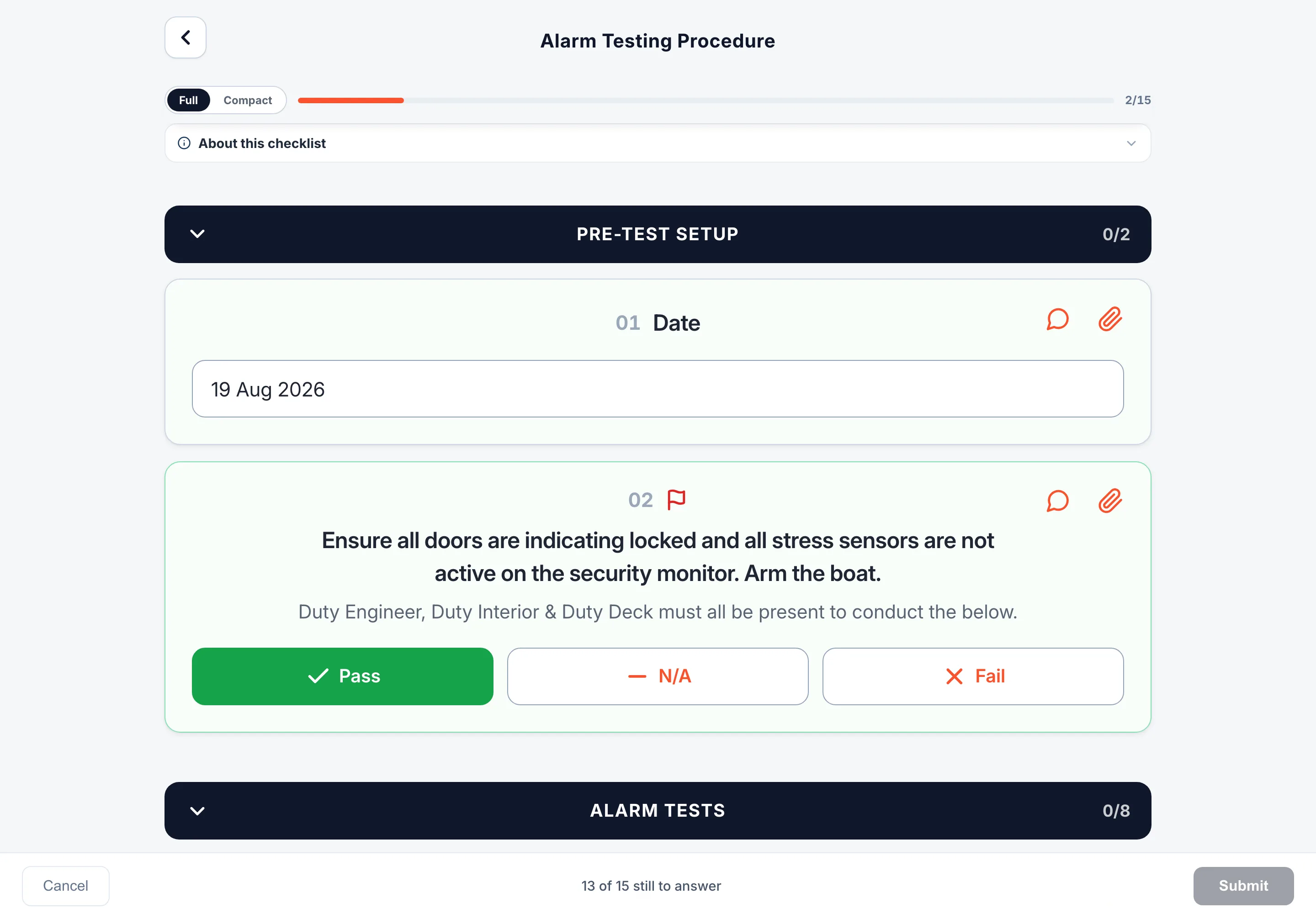
The Alarm Testing Procedure open on the iPad: a Full and Compact view toggle, a progress bar reading two of fifteen, sections for pre-test setup and alarm tests, a date answered, and a critical item marked Pass with room for a note or a photo.
iPad · a round in progress

Bring the ones you already run.

Nobody retypes a hundred-item pre-arrival check. Photograph the laminated card on the bulkhead, or upload the PDF you already have.
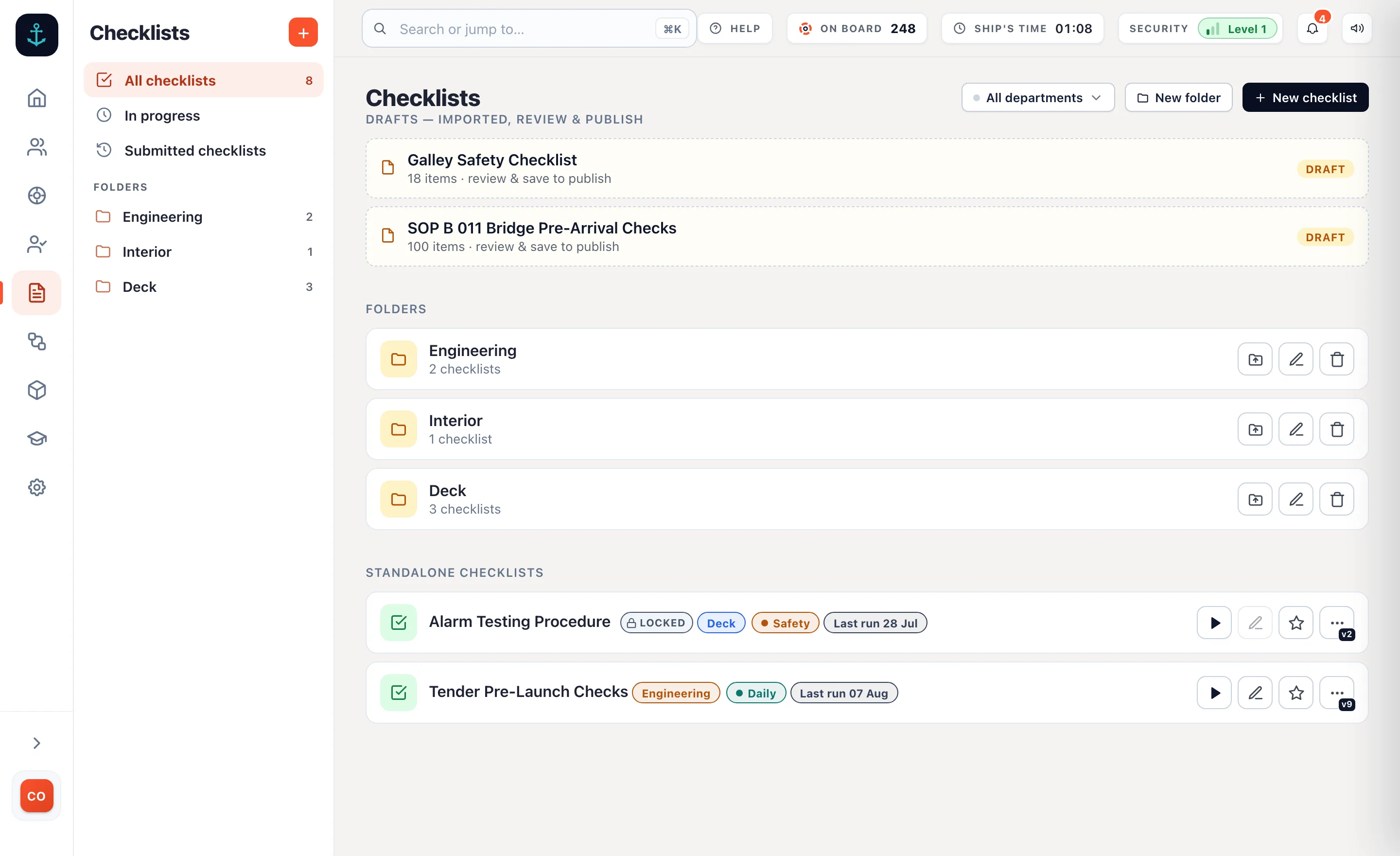
Checklists in the admin: two imported checklists waiting as drafts to review and publish, folders for Engineering, Interior and Deck, and standalone checklists tagged by department and frequency.
Admin · an imported checklist waits as a draft

A photograph or a PDF

The laminated card on the bulkhead, or the scanned checklist out of your safety management system. Layout and nested headings are read as they stand, with no retyping.

It comes back as a draft

Items split out and grouped into their sections, with a response type picked for each one. You read it and change what you want before publishing.

Filed the way you work

Folders for Engineering, Interior and Deck, and tags for the department and how often the check comes round.

Or build one in the admin.

Items go in sections, and each item takes the kind of answer that suits it. The crew's view sits beside you while you write it, so you can see what they will see.
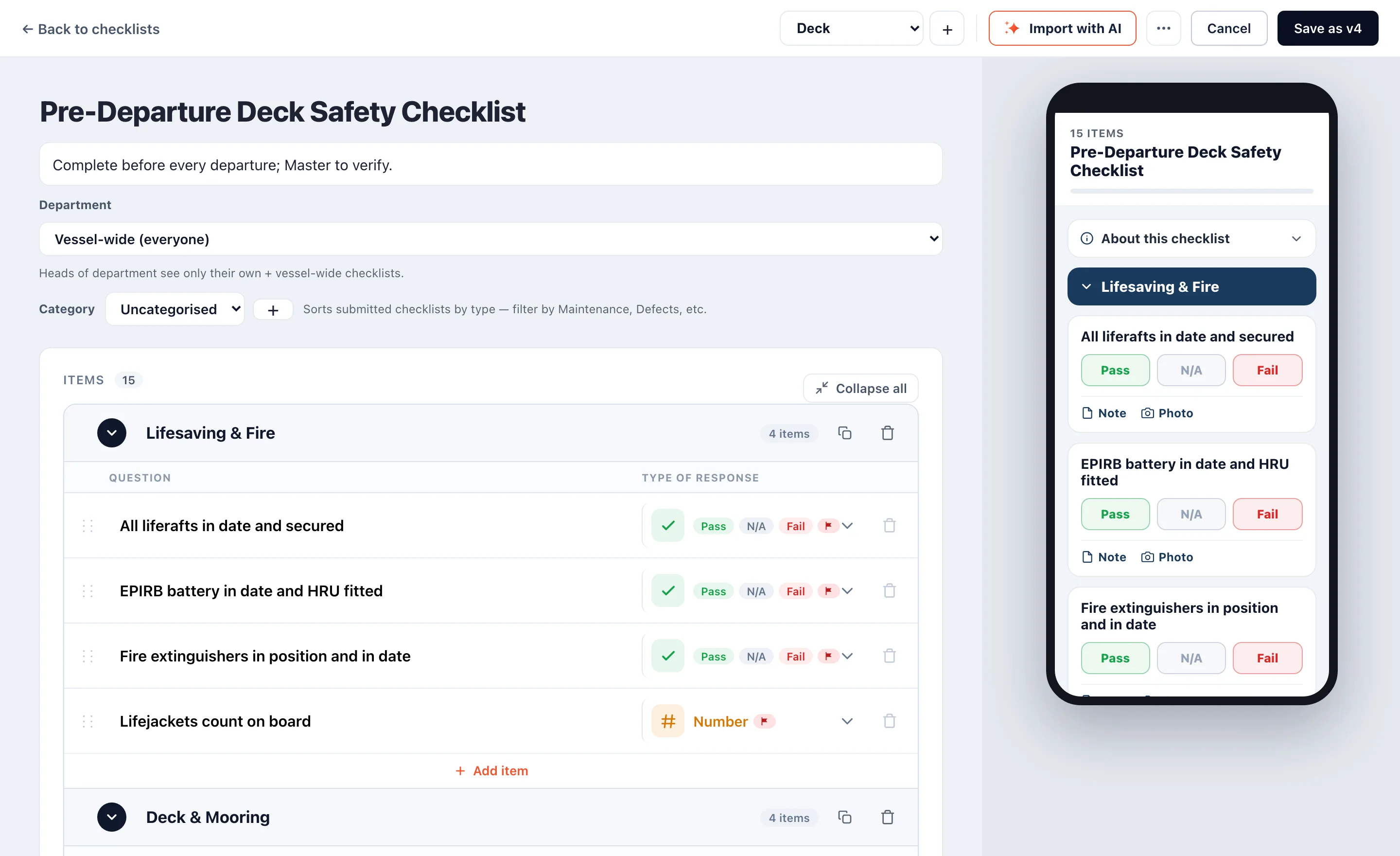
The checklist builder in the admin: a pre-departure deck safety checklist of fifteen items in sections, each item carrying its own response type, beside a live preview of how it looks on a crew phone.
Admin · the builder, with the crew's view beside it

Thirteen kinds of answer

Pass / N/A / fail, multiple choice, a checkbox, typed text, a number, a slider, a temperature, a date, a time, a date and time, a photo, a signature, an instruction.

Four answer scales

Pass / N/A / fail, yes / no, good / fair / poor, and safe / at risk for the items where pass and fail are not the honest answer. The answers that count as a flag raise a follow-up on their own.

Ranges and units

A temperature carries the range it should be in and a number carries its units, so a reading is recorded against what it should have been.

Sections, in the order the round runs

Group the items the way the crew actually walk it, and number them so nothing is missed or done twice.

Flag what is critical

On submission the notification names which critical items failed, so it surfaces the same day rather than at the end of the month.

Decide who is told

The captain, the relevant heads of department, or nobody, by push or by email. Select nobody and nothing sends.

Done where the work is.

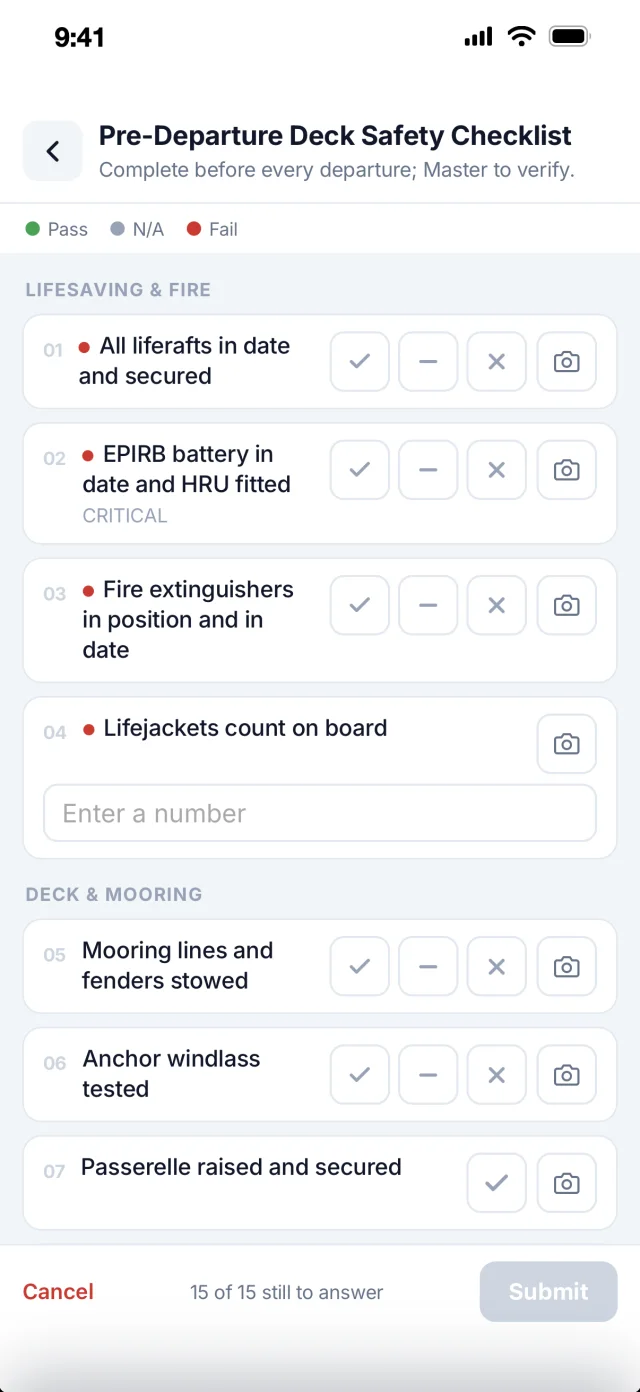
The pre-departure deck safety checklist on a crew phone, grouped into Lifesaving and Fire and Deck and Mooring, with pass, N/A, fail and photo buttons on each item and the EPIRB item marked critical.
Muster Mate · pre-departure deck check
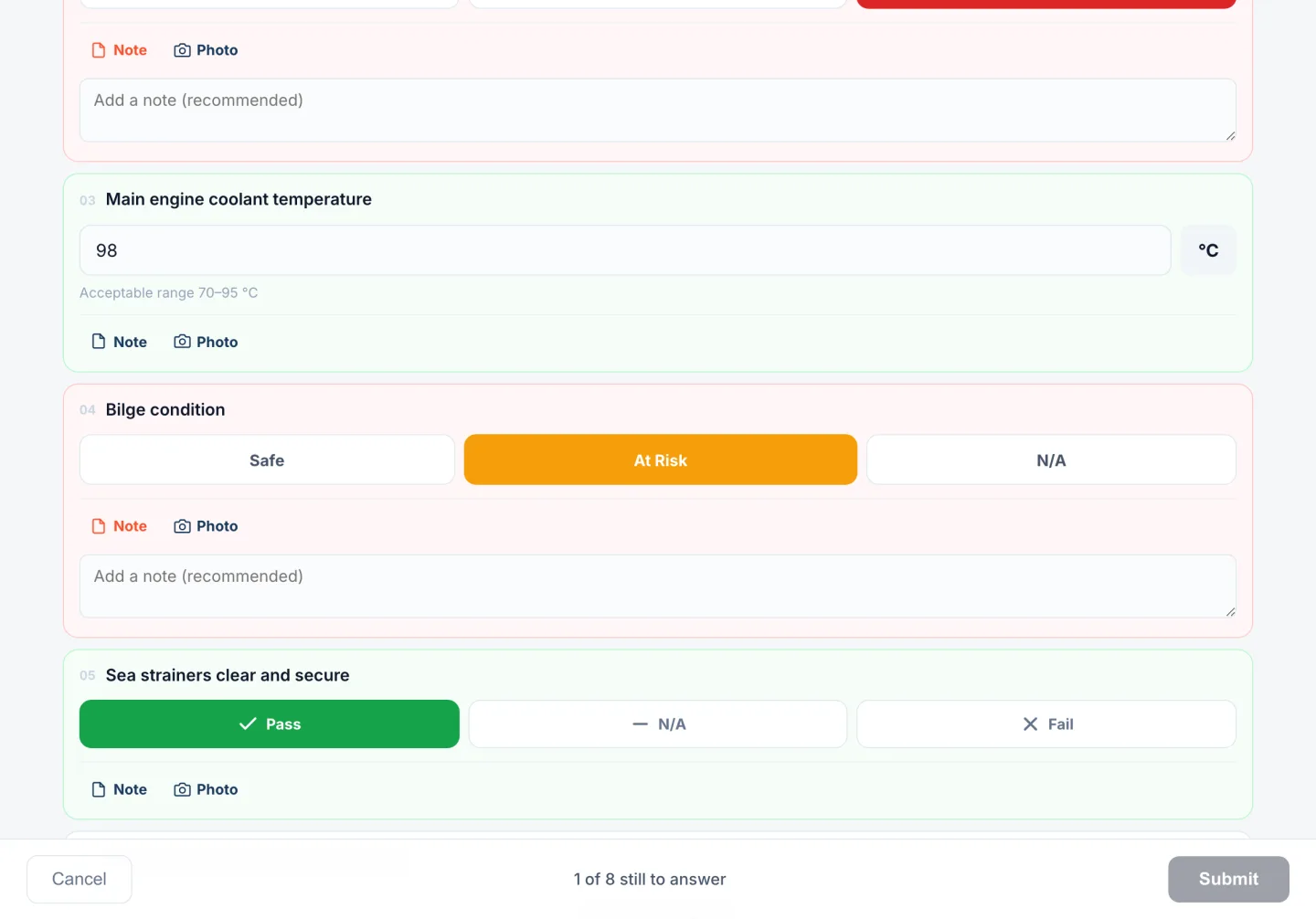
A round in progress: a main engine coolant temperature entered as 98 degrees against an acceptable range of 70 to 95, a bilge condition marked At Risk, and sea strainers marked Pass, with a note and photo control under each item.
A reading against the range it should be in
The Alarm Testing Procedure open on the iPad: a Full and Compact view toggle, a progress bar reading two of fifteen, sections for pre-test setup and alarm tests, a date answered, and a critical item marked Pass.
iPad · sections, numbered items, full view or compact

Daily rounds, pre-departure checks and safety inspections, completed where the work is rather than written up afterwards.

Grouped the way the round runs, with pass, N/A, fail, a note and a photograph on each item, and the items that are critical marked as critical.

Muster Mate is on iOS and Android, for every crew member, on every plan.

A temperature is recorded against its acceptable range, and a reading outside that range fails the item on its own rather than relying on someone noticing.

A photograph can be required rather than optional, and the check will not submit without it.

The same check and the same answers, with a progress count so whoever picks it up knows what is left to do.

On a long round the crew switch to the compact view and work down the list.

Pro

Send it to a department, not a person.

Whoever is on watch picks it up, so nothing sits waiting for one engineer to come back aboard. They all work the same checklist, so the round never gets done twice.
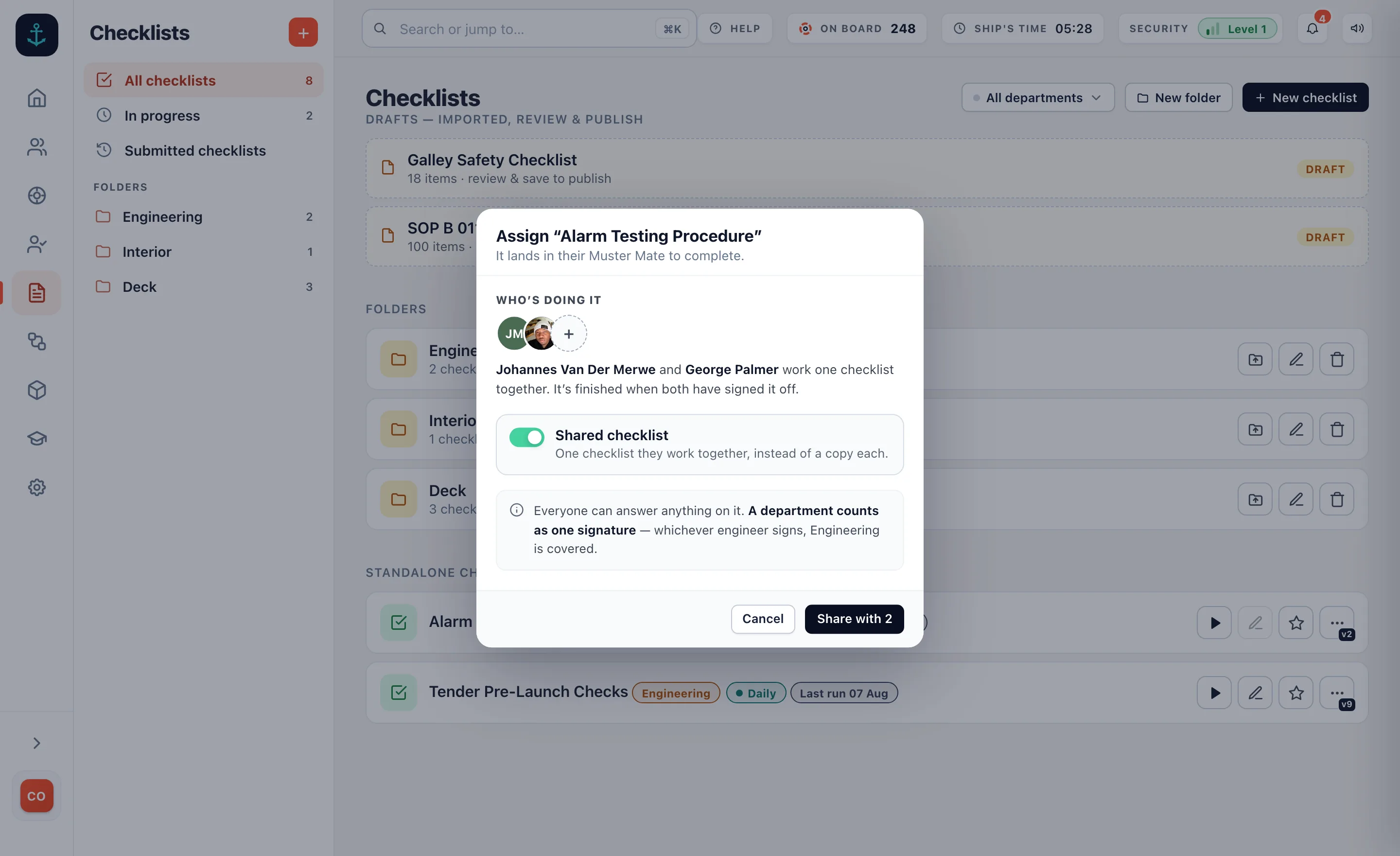
Assigning a checklist in the admin: two engineers picked, a shared checklist switch turned on, and a note that everyone can answer anything and a department counts as one signature.
Admin · picking who a checklist goes to

A failed check becomes a job to do.

Failed and flagged items do not sit in a log waiting to be noticed. They land on the Worklist carrying the check they came from, so the follow-up is tracked rather than remembered.
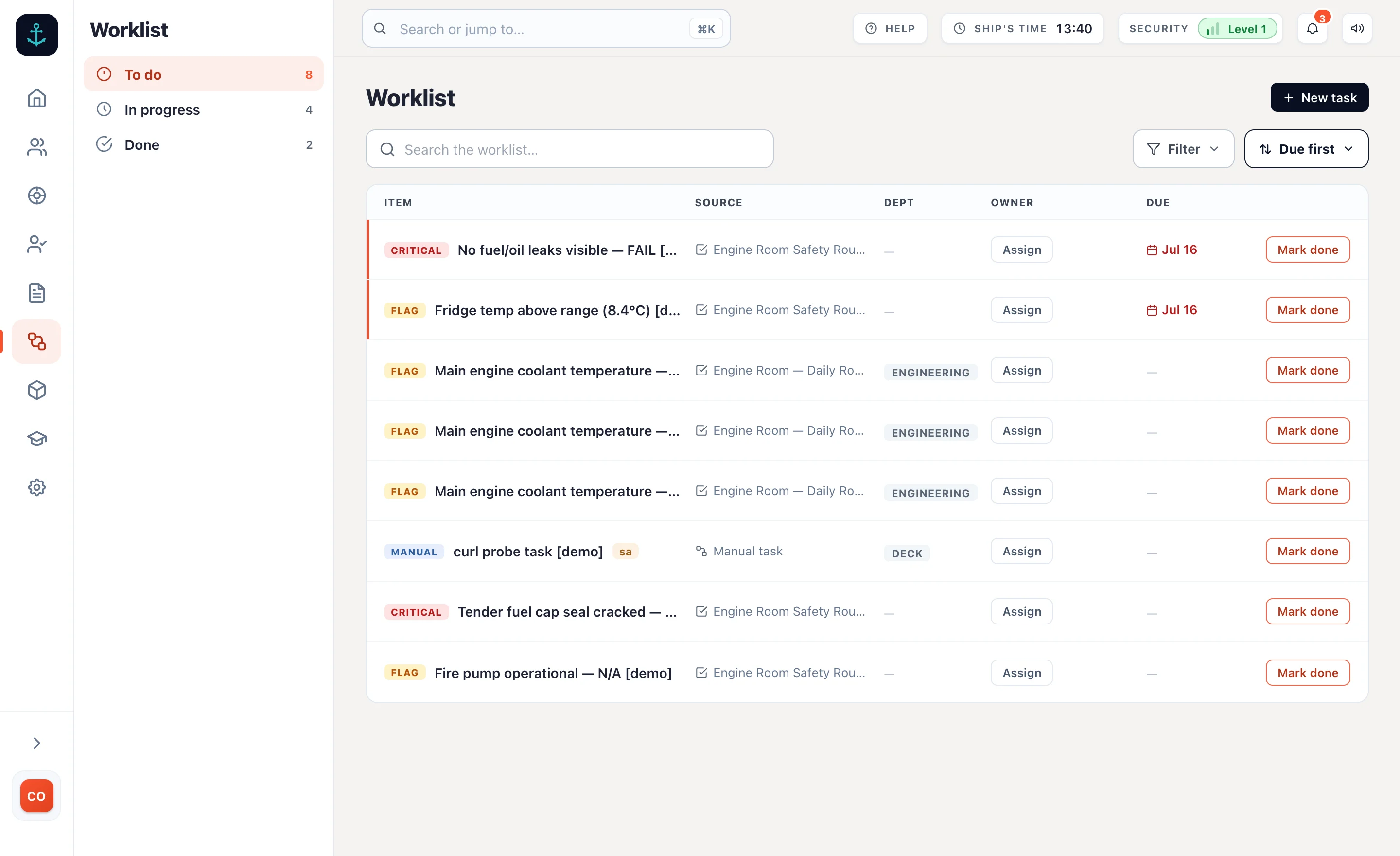
The Worklist in the admin: follow-ups on the To do tab raised by failed and flagged items, each showing the checklist it came from, an assign button, a due date and a mark done button.
Admin · follow-ups to do, and in progress

Assign an owner, set a due date, close each one off. Why an auditor cares about that chain: ISM maintenance and inspections

The record, ready for the folder.

Every check submitted, newest first, with the crew member and rank who completed it and whether any critical item failed.
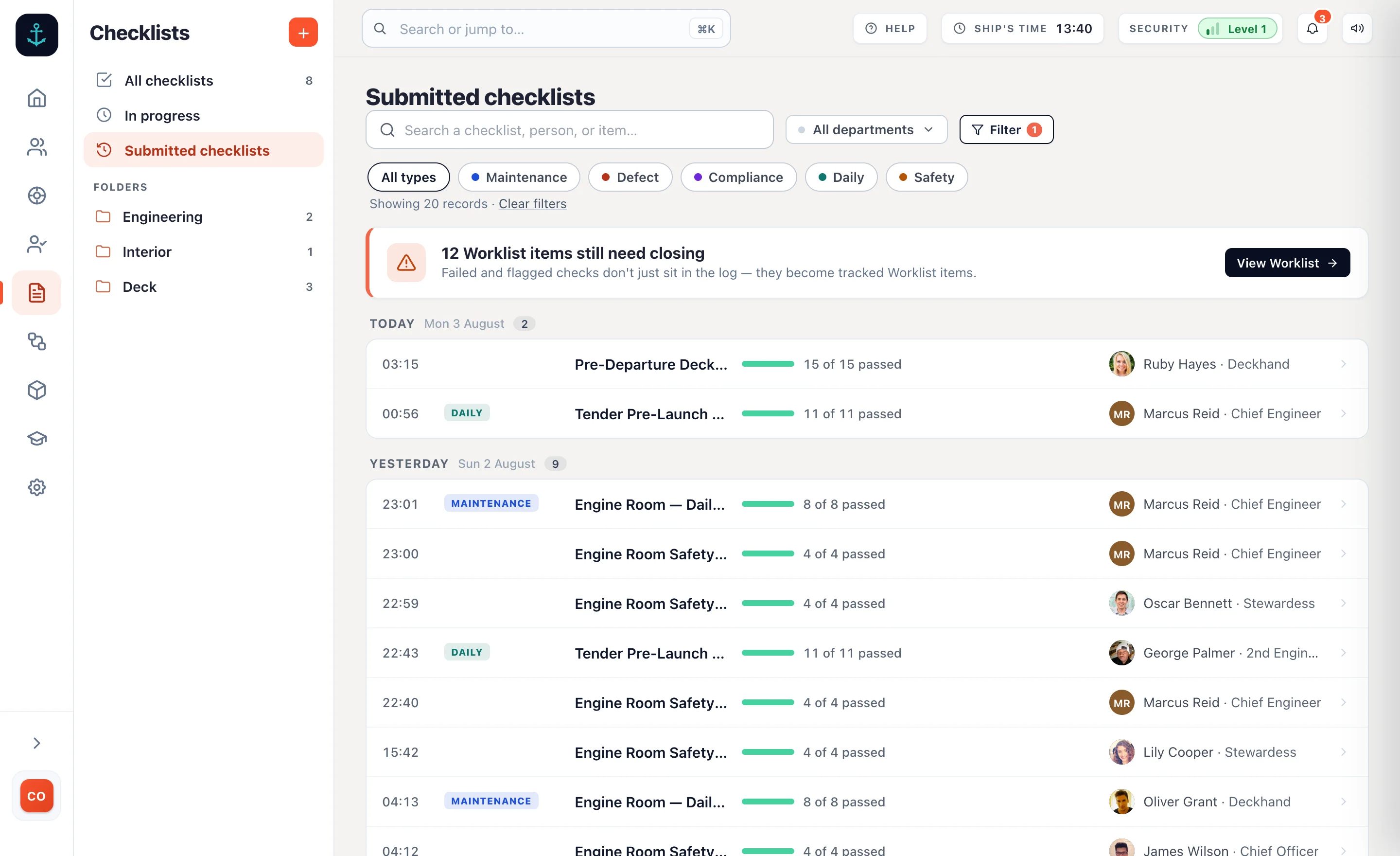
Submitted checklists in the admin, newest first, each row showing the time, the checklist, the crew member and rank who completed it, and whether any critical item failed.
Admin · every check submitted, newest first

Signed with a name

A round is signed off before it will submit. The record carries who completed it, when they started and finished, every answer as it was given, and the notes and photographs attached to each one.

Critical failures called out

A row shows at a glance whether a critical item failed on that round, without opening it.

Exports for the survey folder

One branded record PDF, or a whole date range as an archive foldered by year and month. From Muster Mate, a run of checks exports as a single PDF, one check per page.

Priced for the boat, not the crew list.

Inspection apps built for offices charge per seat, and a yacht has a full crew list that changes every season. Checklists and inspections are part of Pro at £270 a month per vessel, unlimited crew, and the same subscription runs the gangway, the crew board, muster software and drills and MLC hours of rest.

Try it with your crew.

Per vessel, unlimited crew, on the iPads and phones you already have.

Checklists and inspections are part of Pro. 14-day free trial. Refund policy

Paying per seat for an inspection app? The real cost of separate apps